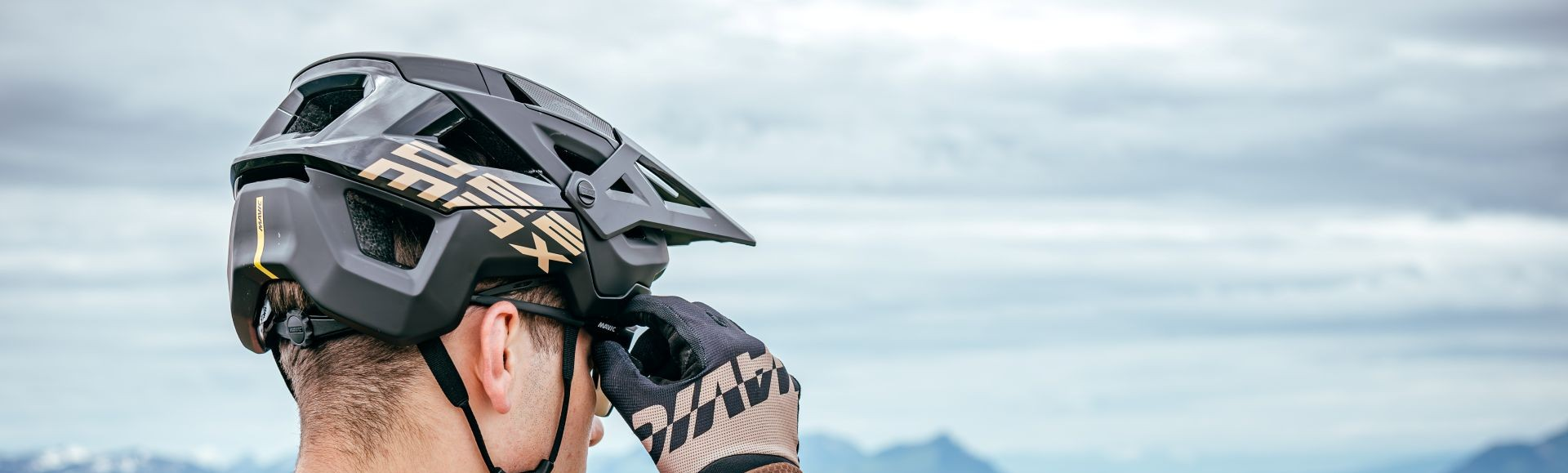
Guide to buying a mountain bike helmet
Categories
The helmet is the most essential piece of safety equipment for mountain biking. Falls are an integral part of the sport, and head injuries are one of the leading causes of serious accidents. Choosing a helmet that is suited to your discipline—cross-country, trail, enduro, or downhill—is therefore not an option, but an essential safety requirement.
Each discipline has its own requirements:
- lightweight and ventilation for Cross-Country,
- versatility and comfort for Trail,
- increased protection for Enduro and DH.
Mavic has developed a range of MTB helmets optimized for performance and safety, incorporating advanced technologies (fastening system, optimized ventilation, MIPS, FidLock buckles, etc.) to offer the best possible protection without compromising on comfort or design.
MTB helmets by type of riding
The first criterion for choosing a helmet is your riding environment. The intensity of the effort and the type of risks involved differ radically between a cardio ride and a technical descent.
Cross-Country MTB helmet
Who is it for? Cyclists looking for physical performance, efficiency, and endurance. In this discipline, the average speed is high and the cardio effort intense. The helmet must provide excellent heat dissipation and not weigh down the neck. It offers the perfect balance between aerodynamics and airflow.
- If you're looking for a helmet for leisure/touring, the Crossride SL Elite is the perfect choice. It's a versatile, very lightweight model, perfect for Sunday rides and training sessions alike.
Trail/Enduro MTB helmet
Who is it for?
Adventurers who climb to descend better and explore all types of trails. Here, the helmet must protect the back of the head and temples more than a road model, while remaining ventilated enough for climbs.
Essential criteria for choosing the right MTB helmet
Beyond style, four pillars define the quality of a helmet.
Safety and Standards
All Mavic helmets comply with (and often exceed) the CE EN 1078 standard.
- Outer shell: distributes impact over a large surface area and prevents objects (stones, branches) from penetrating.
- Absorption: the inner foam (EPS) deforms to absorb energy.
- Rotational technologies: systems such as MIPS (featured in our ranges) allow the shell to move slightly relative to the head during an oblique impact, reducing the rotational forces transmitted to the brain and limiting the risk of concussion.
Discipline Use Helmet priorities Typical ventilation Why Cross-Country (XC) Forest trails and XC courses Lightweight, good ventilation, comfort, aerodynamics Lots of openings/wind, ventilated shell/open face Prolonged effort, climbing, heat → importance of heat dissipation and comfort Enduro/Trail/All-Mountain Pedaling uphill, challenging descents, trails and bike parks Good compromise between protection / comfort / ventilation / versatility Adequate ventilation, visor, good rear coverage / jet or ¾ helmet Need for protection on descents + comfort on climbs / transitions → compromise between ventilation & safety DH Very challenging, exclusively downhill, track or bike park Maximum protection, sturdy shell, support, possible chin guard (full face) Less emphasis on ventilation, more compact/covering structure Less pedaling effort → ventilation is less crucial, priority given to safety in the event of a violent impact
Comfort and fit
A poorly fitting helmet is useless. If it moves during an impact, it will not absorb the shock in the right place.
Two crucial components:
- Occipital support: the rear tightening system must wrap around the skull without any pressure points.
- Straps and chin strap: they must form a perfect "Y" under the ear and be tightened so that only two fingers can fit under the chin.
A good helmet should "stay in place" even when shaking your head—without sliding forward (which would obstruct your vision) or backward (which would expose your forehead). The fit sometimes depends on the shape of the head (round, oval, etc.) and body type—a helmet that is comfortable for one person may not be comfortable for another. In conclusion: a precise fit + occipital support + well-adjusted straps = maximum safety + comfort, especially when mountain biking, where jolts, vibrations, and shocks are frequent.
Visor & Accessories
Essential for mountain biking, the visor has several functions:
- Reduction of glare/sunlight. It blocks direct sunlight, reduces glare and reflections, improving visual comfort and safety when riding uphill or downhill.
- Protection from rain, mud, and splashes. In case of rain, mud, or when following another mountain biker, the visor prevents water, mud, or splashes from getting into your eyes.
- Safety in case of impact. In some cases, the visor can help deflect branches or objects coming towards your face, providing a minimum of additional protection, even if this is not its main function.
Technologies & innovations
MIPSErgo Hold SL+ fastening system
Fidlock® magnetic buckle
VisorReflective elements
Glass GarageInsect net
Ventilation Straps Goggle compatibility Deemax Pro MIPS Yes Yes Yes Adjustable Yes Yes Coolmax® EarFit strap Yes Deemax Trail Yes Adjustable Yes Yes Coolmax® Lockstrap Yes Crossride SL Elite Yes Removable Yes Yes Technology37.5® Lockstrap Comète SL MIPS Yes Yes Yes YesInternal ventilation channels
EarFit strap Comète Ultimate 2 MIPS Yes Yes Yes Yes Yes
Internal ventilation channels
EarFit strap
How to choose the right size?
Trying it on is key. A helmet that is too big will tip forward (obstructing your vision) or backward (exposing your forehead).
Trying it on is often overlooked... but it is the key to an effective helmet:
- Nothing can replace trying the helmet on your head: check that it fits well (neither too tight nor too loose), that it stays in place, that it doesn't get in the way, and that it doesn't move.
- Check the adjustment of the occipital wheel/retention system—it should fit the shape of your head and provide a secure fit.
- Side straps + chin strap: the buckle under the chin must be properly adjusted (it is often recommended that you be able to slide 1–2 fingers between the chin strap and your chin).
- If the helmet is too big, too small, or poorly adjusted, it will be uncomfortable.
Maintenance & cleaning of a mountain bike helmet
Regular maintenance
- Cleaning: warm water + mild soap only. Never use solvents or chemical sprays that attack polystyrene.
- Drying: in the open air, away from radiators or direct sunlight (UV rays weaken plastics over time).
- Hygiene: the internal foam pads are removable on Mavic helmets: wash them regularly to prevent bacteria growth from perspiration.
When should you replace a helmet? (lifespan & signs of wear)
- After ANY violent impact: even if no cracks are visible to the naked eye, the internal EPS structure has been compressed and will no longer perform its function. Never repair a damaged helmet; always replace it.
- Every 3 to 5 years: materials (adhesives, foams, plastics) age naturally with UV exposure, heat, and sweat, losing their elasticity and absorption capacity.
News & advice
Apr 13, 2026Choosing Your Road Cycling Shoes: 3 Rides, 3 Needs If you are looking for the pair of road cycling shoes that best suits you, start by defining the type of ride your are going on. Mavic outlines the three distinct rides to help you select a pair of shoes specifically developed to meet those unique requirements.
Mar 25, 2026Guide to Cycling Shorts: How to Choose the Right Pair? Choosing cycling shorts isn’t just about comparing materials or cuts. What really matters is how you feel in the saddle as the miles go by: support, stability, pad comfort, moisture management, and freedom of movement. It’s important to know that a good pair of cycling shorts is one of the most important pieces of gear for riding long distances in comfort. At Mavic, this standard guides the development of every men’s and women’s cycling shorts, with solutions designed for ride duration, season, and desired intensity level.